CRM is Dead. Long Live the Semantic Spine.
Strategic Whitepaper. March 2026
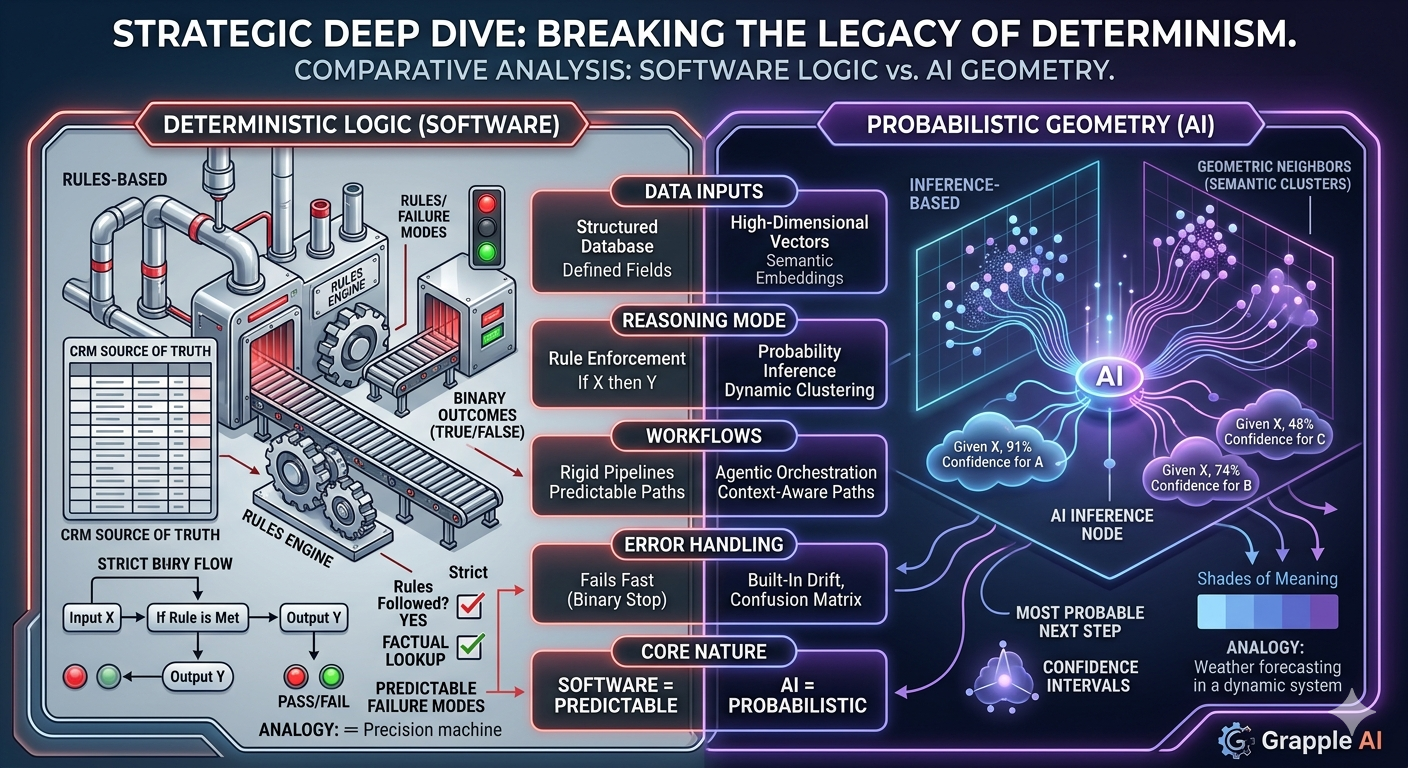
Why AI as "Geometric Probability" Changes Enterprise Strategy Forever.
The Question: If AI is not a database, not a lookup engine, and not a deterministic system—but a probability‑driven navigator of high‑dimensional geometry—what does that change for your operating model?
The Answer: It doesn’t just move the goalposts; it changes the shape of the field.
Most "AI experts" are still treating LLMs like faster search engines. They are wrong. Here is the structural breakdown of the shift from Deterministic Software to Probabilistic Geometry.
1. The Shift: AI is Geometry, Not Logic
Most organisations treat AI as a smarter rules engine. But AI is a probability engine moving through a high‑dimensional vector space.
It doesn't "know" facts: It predicts the next most probable coordinate in a geometric space.
It doesn't "follow rules": It follows patterns shaped by training data.
The Implication: If your strategy treats AI as "software that doesn't make mistakes," your strategy is built on a flaw. AI introduces Semantic Drift and Silent Failure Modes.
2. Breaking the Deterministic Legacy
Traditional enterprise systems (CRM, ERP, Case Management) are built on Deterministic Logic: If X, then Y. AI operates on Probabilistic Logic: Given X, there is an 87% probability that Y is the relevant neighbor.
This breaks the old operating model. Traditional systems assume:
Structured, human-verified data entry.
Stable, predictable workflows.
Binary "Correct/Incorrect" outcomes.
The Grapple AI Reality Check: Your old architecture is rigid. AI is fluid. Forcing a probabilistic engine into a deterministic box is why most AI pilots fail to scale.
3. CRM: From "The Brain" to "The Spine"
In the old world, the CRM was the "Source of Truth"—the brain of the company. In the AI world, the CRM is moving down the stack.
A. CRM as the Structured Anchor: AI doesn't "read" fields; it reads vectors. The CRM becomes the Structured Spine while the AI acts as the Semantic Layer.
B. The End of the Interface: If AI is the orchestrator, humans no longer need to click through screens or fill in forms. AI writes to CRM. AI reads from CRM. Humans talk to AI.
C. Verification over Interaction: The CRM's primary role shifts from "data entry system" to "Audit and Verification Layer." It becomes the safety guardrail for the AI's probabilistic outputs.
4. The Contact Centre: 80/20 Orchestration
Understanding AI as geometry explains why the Contact Centre is the first to be disrupted. AI excels at classification and pattern matching (the geometry of conversation) but fails at ethical judgment and factual precision.
The New Operating Model:
AI-Led (80%): Classification, summarisation, and routine reasoning.
Human-Led (20%): High-risk cases, empathy-heavy triggers, and ethical edge cases.
CRM-Led: The orchestration layer for compliance and audit.
5. The Evolution of Enterprise Architecture
The shift from the "Old Deterministic EA" to the "New Probabilistic EA" is the biggest architectural pivot since the move to the Cloud.
❌ Old EA → ✅ New EA
❌ Rigid Data Schemas → ✅ Vector Stores
❌ UI-Driven Systems → ✅ Agentic Orchestration
❌ Rule-Based Logic → ✅ Knowledge Graphs
❌ Human-Entered Data → ✅ Semantic Routers
❌ Static Workflows → ✅ Evaluation Pipelines
The Final Word
CRM isn't dying; it is being liberated. By removing the burden of being the "Interface" and the "Brain," the CRM can finally do what it was meant to do: provide a stable, audited foundation for customer relationships.
Is your architecture ready for the shift from Logic to Geometry?
"Strategy is no longer about building the best workflow; it’s about navigating the best probability." — Grapple AI